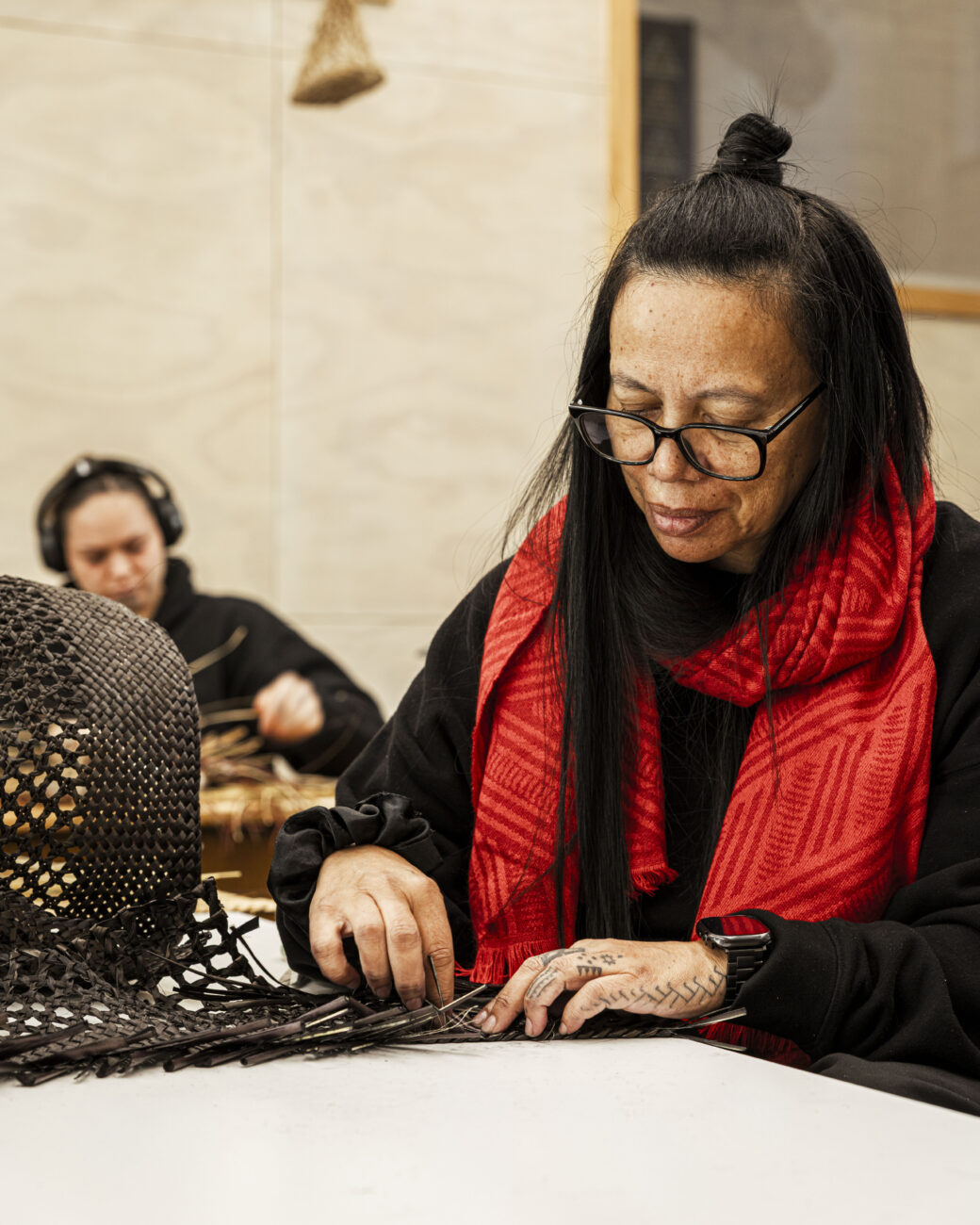
Ancestral knowledge, weaving and contemporary design come together as New Zealand Māori Arts and Crafts Institute (NZMACI) collaborates with Shona Tāwhiao for The House of Harakeke at New Zealand Fashion Week (NZFW).
NZMACI brings Māori weaving to the runway
One hundred years after the Māori Arts and Crafts Act 1926 established schools dedicated to the study and practice of Māori arts and crafts, NZMACI is continuing that legacy in a distinctly contemporary setting — the runway of New Zealand Fashion Week.
As part of Kāhui Collective’s 2026 programme at New Zealand Fashion Week (NZFW) on Thursday 20 August, weaver and designer Shona Tāwhiao (Ngai Te Rangi) launched The House of Harakeke, six woven pieces which involve a collaboration with NZMACI’s Te Rito o Rotowhio, National Weaving School. The collection is about the versatility of the fibre.
Tāwhiao and Kāhui Collective founder and designer Kiri Nathan spent a week-long wānanga with Marsters at the National Weaving School at the end of May, before Tāwhiao invited NZMACI tauira (students) and pouako (tutors) to continue working alongside her on the collection.
“The students assisted with two of the six looks while Cori has been supporting the mahi 100%, and being able to use the resources at Te Rito o Rotowhio has been invaluable,” she explains.
Marsters joins NZFW from Darwin, where he has been at the Indigenous Weaving Conference. He modeled on the runway for Kāhui Collective designers and he also collaborated with designer Bobby Luke Campbell for Te Aho Tapu – The Sacred Thread at Auckland Museum, where piupiu he has made featured.
From harakeke to The House of Harakeke
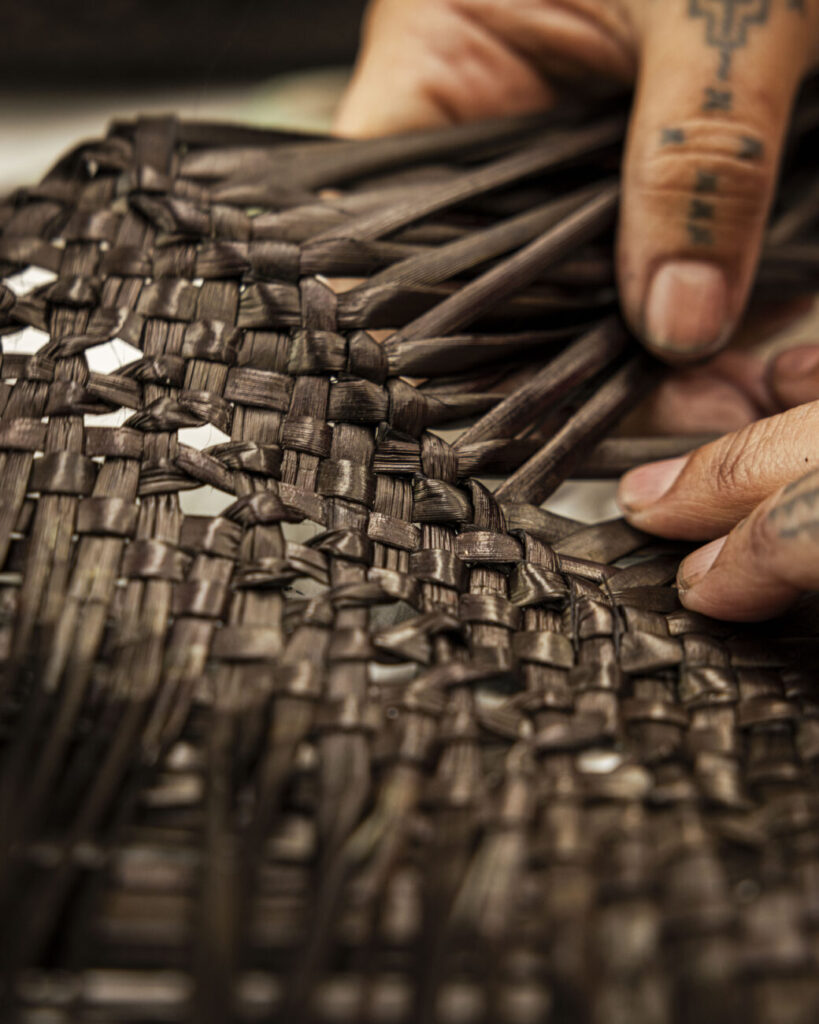
The House of Harakeke
Tāwhiao (Ngāi Te Rangi, Whakatōhea, Te Whānau-ā-Apanui) and Kāhui Collective founder and designer Kiri Nathan (Ngāpuhi, Ngāti Hine, Ngāti Hauā, Ngāti Maru and Ngāti Paoa) spent a week-long wānanga with Marsters at the National Weaving School at the end of May, before Tāwhiao invited NZMACI tauira (students) and pouako (tutors) to continue working alongside her on the collection.
The collaboration began with the harvesting of harakeke.
“The first thing we did was harvest a truckload of muka harakeke. Then the four tauira and five raranga kaiako spent the next two days preparing hundreds of pokinikini (cylindrical flax),” says Tāwhiao.
“I’m hoping the collaboration will inspire the tauira to take their weaving skills further in their careers. The collection is called The House of Harakeke, which has a connection to Te Rito o Rotowhio and the harakeke that it’s made from.”
When Māori weaving meets contemporary fashion
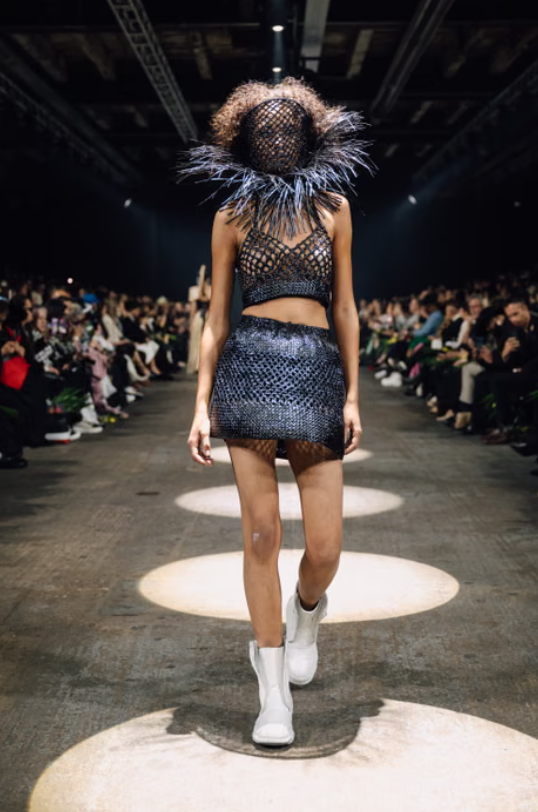
Photo credit: New Zealand Fashion Week
For Tāwhiao, the relationship between fashion and Māori weaving also challenges conventional ideas about where high-end fashion is made.
“In Europe, designers have ateliers and staff who make their collections, and this is what it was like being at the New Zealand Māori Arts and Crafts Institute for me at Whare Pora Te Rito o Rotowhio.
Marsters explains this idea further.
“When our harakeke garments meet other garments – it’s deliberate.
“Indigenous ancestral exclusiveness is remembered through time and hands.”
Weaving, whiri and the transmission of knowledge
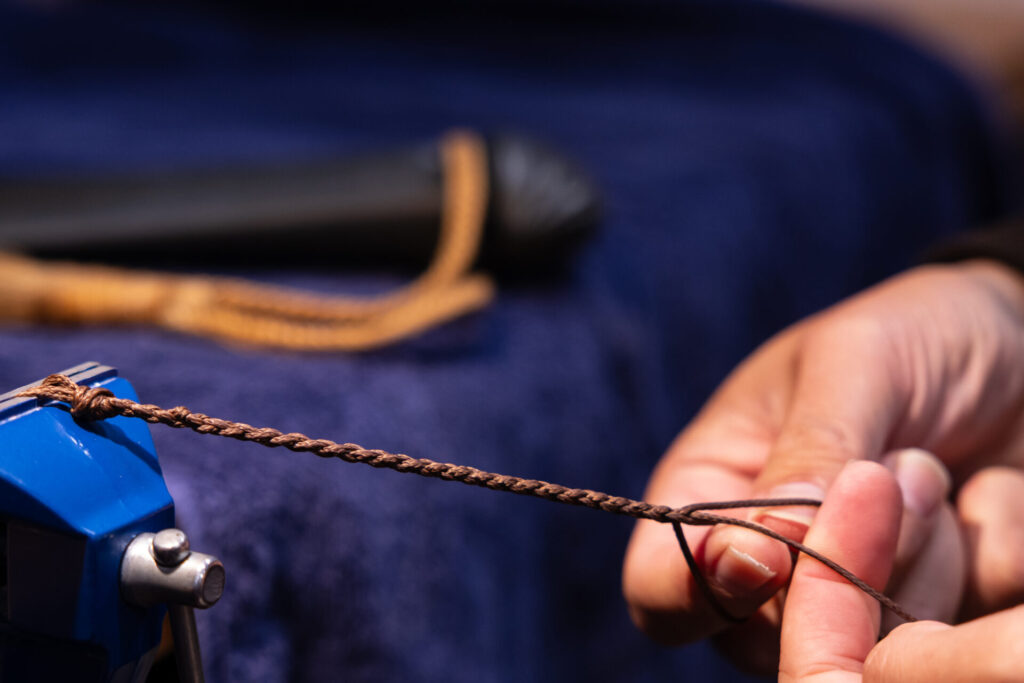
The whiri (braiding) workshop
The collaboration is one part of a wider NZMACI presence across Kāhui Collective’s 2026 programme, bringing Māori, Pasifika and Indigenous designers together through runway, retail and cultural programming.
Alongside the runway, NZMACI featured in the Kāhui Collective Indigenous Fashion Symposium, including a presentation exploring Hae Whakarewa, the award-winning distinctive typeface developed for NZMACI, and a hands-on Whiri (Braiding) Workshop: Threads of Connection led by Tumu Te Takapū o Rotowhio (Head of the National Stone and Bone Carving School) Stacy Gordine (Ngāti Porou).
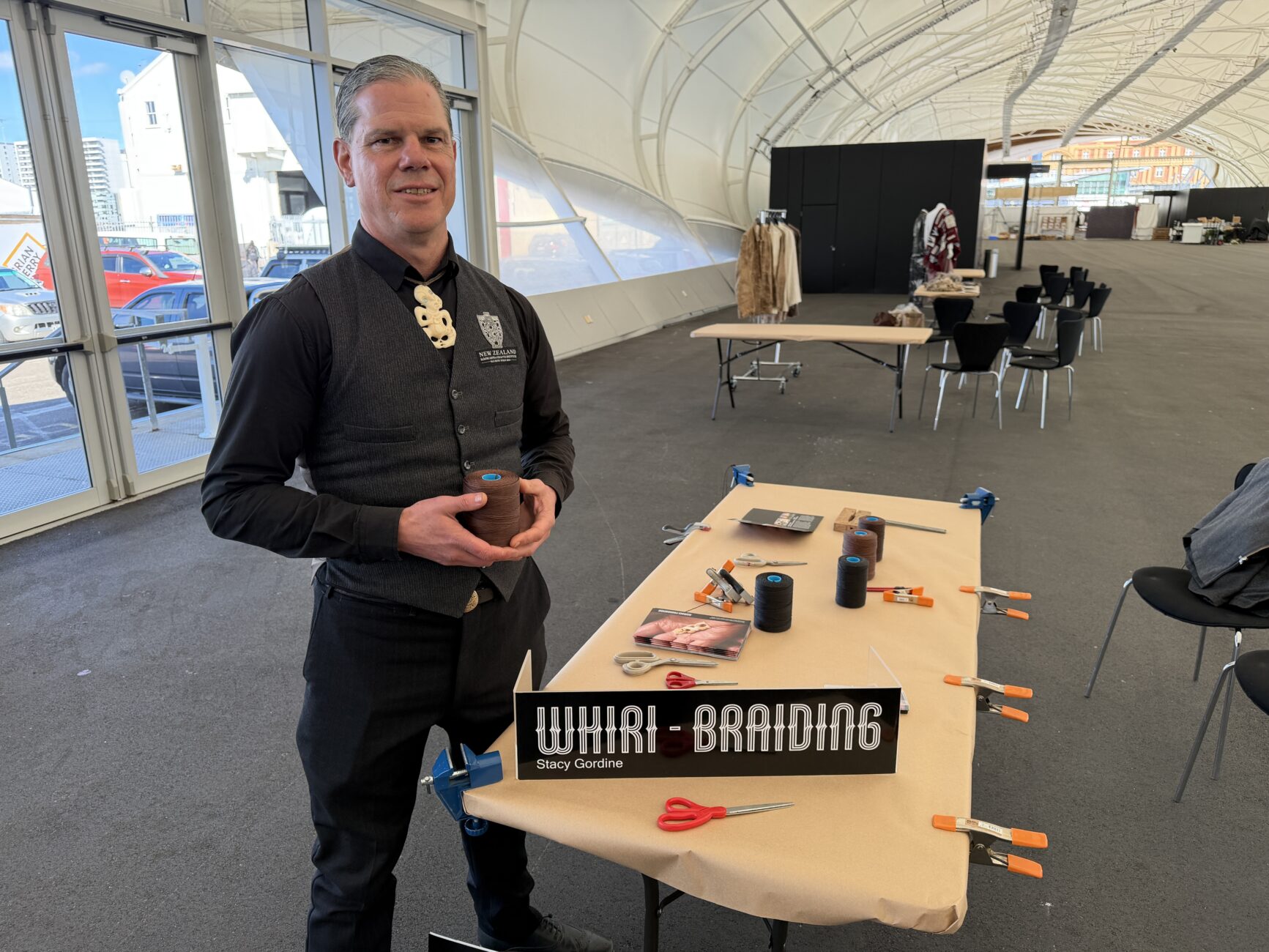
Stacy Gordine at the whiri workshop for NZFW.
The typeface Hae Whakarewa was developed through a collaboration between Gordine and Guardians Agency as part of the creation of the NZMACI Foundation identity. The typeface draws on Māori design principles and incorporates references to the three NZMACI wānanga — wood, stone and bone, and weaving.
The whiri (braiding) workshop explored traditional three-, four-, five-, seven-, eight- and 12-strand techniques, including finishing and binding. More than a technique for braiding, whiri carries matauranga (knowledge) of connection, strength and collective practice.
At NZMACI, whiri is taught as a foundation for tauira before they progress into specialist carving practices, developing patience, discipline, rhythm and cultural understanding alongside practical skill.
NZMACI also bought its Āhua Gallery to the Kāhui Collective retail activation, showcasing contemporary taonga created by tauira across weaving, wood carving, and stone and bone carving.
General Manager NZMACI Commercial and Foundation Ariki Tibble says NZMACI is constantly navigating the balance between sustaining, protecting and passing down mātauranga around traditional Māori arts and crafts, while ensuring those traditions continue to live and find expression in a contemporary world.
“Fashion Week is a great example of that, taking knowledge grounded in generations of practice into a new creative space, while keeping its integrity at the centre.”
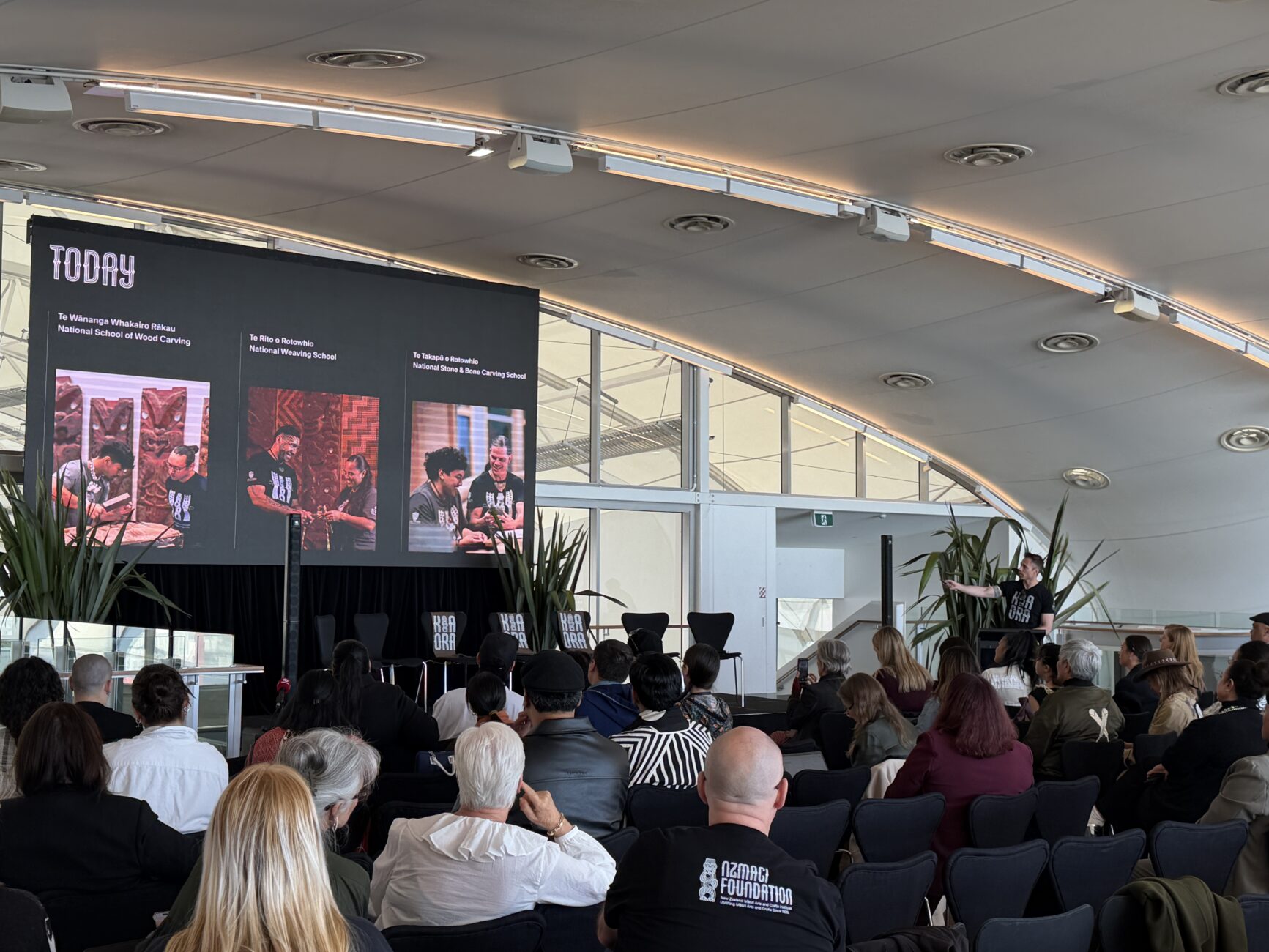
Ariki Tibble presenting at the NZFW symposium.
About the artists
Tumu Te Rito o Rotowhio (Head of the National Weaving School) Cori Marsters
Cori Marsters (Te Arawa, Te Whakatōhea) is Tumu of Te Rito o Rotowhio, NZMACI’s National Weaving School, and an Aotearoa renowned weaver whose work has been exhibited locally, nationally and internationally. A graduate of the NZMACI wood carving school, Cori was drawn to weaving through the influence of his nan and others who nurtured him in mahi raranga and whatu. At Te Matatini 2025, his group Te Kapa Haka o Ngāti Whakaue won, and Cori was named Manukura Tāne — New Zealand’s top male kapa haka performer. His weaving has included an exhibition at the Spirit Wrestler Gallery in Vancouver; in 2016 he received the Ngā Manu Pirere, Emerging Māori Artist Award, and one of his kete was used for a New Zealand stamp in the Matariki collection.
Tumu Te Takapū o Rotowhio (Head of the National Stone and Bone Carving School) Stacy Gordine
Stacy Gordine (Ngāti Porou) is an internationally recognised Māori artist whose practice spans pounamu, bone, stone, wood, silver and multimedia, from intricately carved adornments to large-scale public installations and typography. His work is held in the collections of Te Papa, Pātaka Art + Museum and The Dowse Art Museum, as well as private collections worldwide. He has undertaken artist residencies and Indigenous cultural exchanges in Alaska and Hawaiʻi. His recent work includes leading the design of the Hae Whakarewa typeface for NZMACI, creating the Te Ahi Tūpua sculpture in Rotorua, and contributing to the design of New Zealand’s next-generation passport.
About the New Zealand Māori Arts and Crafts Institute
The New Zealand Māori Arts and Crafts Institute (NZMACI) operates on-site at Te Puia and includes Te Wānanga Whakairo Rākau – National Wood Carving School; Te Takapū o Rotowhio – Stone and Bone Carving School; and Te Rito o Rotowhio – the National Weaving School.
The New Zealand Māori Arts and Crafts Institute Vesting Act 2020 has a purpose to encourage, foster and promote ahurea and toi Māori (culture and Māori arts) of Aotearoa New Zealand. At its core, NZMACI is about the protection and transfer of traditional mātauranga Māori knowledge, with a focus on education, national outreach and global outreach.
Event information
Kāhui Collective Indigenous Fashion Symposium
Tuesday 18 August | 10am–4.30pm
The Cloud, Queen’s Wharf11:00am: NZMACI Presentation, Hae Whakarewa: Typeface and Brand — Stacy Gordine and Anzac Tasker.2:00pm – 3:00pm — Wānanga Whiri (Braiding): Threads of Connection with Stacy Gordine.
Kāhui Collective Runway Shed 10, Auckland
Thursday 20 August | 6pm
Featuring Shona Tāwhiao’s The House of Harakeke, including six woven pieces created in collaboration with NZMACI’s Te Rito o Rotowhio.
Kāhui Collective Retail Activation – NZMACI Āhua Gallery
Tuesday 18 – Thursday 20 August | 12–6pm
The Cloud, Queen’s Wharf NZMACI taonga available for purchase.