A New NZMACI Student Intake begin their Journey
Twelve tauira from across Aotearoa have begun a journey that will help shape the future of traditional Māori arts after being welcomed to the New Zealand Māori Arts and Crafts Institute (NZMACI) at Rotowhio Marae.
The tauira (students) have been selected to study in NZMACI‘s nationally recognised wānanga of Te Wānanga Whakairo Rākau (National Wood Carving School), Te Takapū o Rotowhio (National Stone and Bone Carving School), and Te Rito o Rotowhio (National Weaving School), continuing a legacy that stretches back almost a century to the vision of Tā (Sir) Apirana Ngata.
Acting General Manager NZMACI Ranginui Rikirangi-Thomas said every intake represented another generation entrusted with carrying mātauranga Māori into the future.
“When you look at the history of the New Zealand Māori Arts and Crafts Institute and why these wānanga were established, it’s about ensuring this taonga continues to thrive through future generations.
“We are privileged to pass this mātauranga on to these tauira, who will one day return home to strengthen the knowledge, capability and traditions of their own whānau, hapū and iwi.”
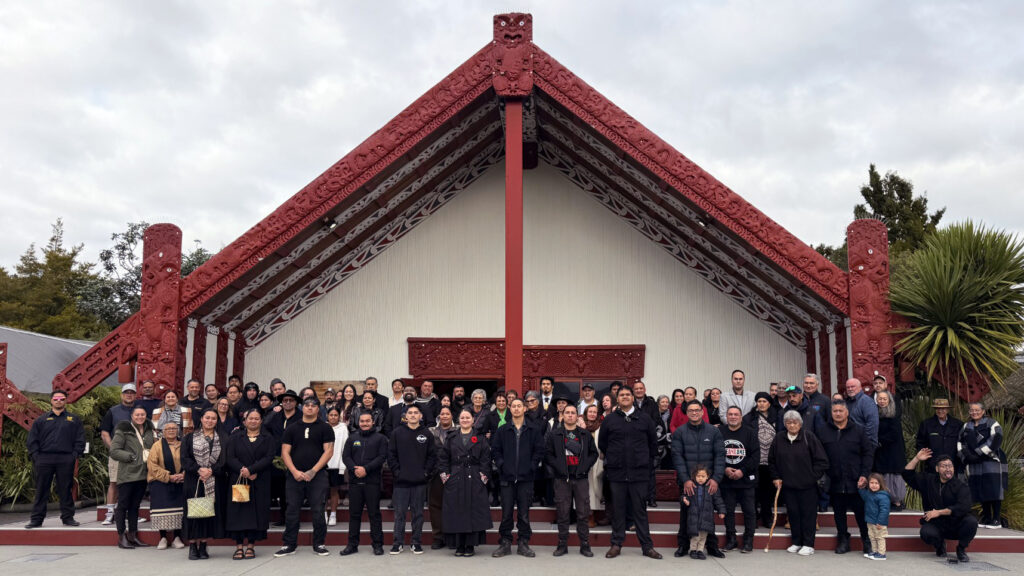
The 12 new NZMACI tauira are welcomed during a pōhiri at Rotowhio Marae to begin their studies in the nationally recognised schools of carving and weaving.
Each intake is intentionally small, with four tauira accepted into each wānanga, allowing intensive teaching from NZMACI tohunga and ensuring traditional knowledge is passed on to the highest standard.
Among the new intake is Te Takapū o Rotowhio tauira Kahn Basher (Ngāti Ranginui, Ngai Te Rangi) and Whakairo Rākau tauira Taiwhanake Waaka-Peters (Ngāti Ranginui) whose arrival was acknowledged by Ngāti Ranginui Chair Charlie Rahiri in his whaikōrero.
Rahiri reflected on the longstanding relationship between Ngāti Ranginui and NZMACI, noting generations of iwi members who have contributed to the Institute’s legacy.
“Today felt like a homecoming. We’ve had so many of our young people come through here and learn this art form before taking that knowledge back to Tauranga. It’s special when our uri choose to come to NZMACI to hone their craft.
“We owe so much to this school and the many ihorangi it has produced, not only for Ngāti Ranginui but for te ao Māori. In spite of what’s happening around us, we carry on.”
Rahiri said the relationship between Ngāti Ranginui, Tūhourangi and Te Arawa stretched back generations through shared whakapapa.
One of those enduring connections was Master Carver Tuti Tūkaokao (Ngāti Ranginui, Te Arawa), who, alongside Hōne Te Kāuru Taiapa QSM, taught the inaugural intake of tauira at NZMACI in 1967, including current NZMACI Tohunga Whakairo Rākau Clive Fugill (Ngāti Ranginui, Ngāi Te Rangi, Ngāti Raukawa, Ngāti Rangiwewehi).
During that first year, Tūkaokao and Fugill carved Hangarau Marae in Tauranga. Tūkaokao also led the carving of Tauranga’s 14-metre ceremonial waka taua, Te Awanui, from a 300-year-old kauri.
“We’ve had generations of people who have left their imprint in both Te Arawa and Tauranga. Those connections continue today.”
For Basher, studying whakairo is deeply personal.
“This is the step I’ve needed to take and I’m looking forward to the mātauranga journey. I want to learn as much as I can, absorb it, and take that knowledge home so I can teach others.”
Another tauira beginning her journey is Mercia-Dawn Wharerau (Tūhourangi-Ngāti Wāhiao, Ngāti Pikiao), granddaughter of the late Emily Schuster QSM, the inaugural head tutor of Te Rito o Rotowhio.
Schuster was widely recognised as one of Aotearoa’s foremost weaving practitioners, preserving and sharing traditional raranga knowledge for more than three decades, teaching throughout Aotearoa and internationally, while helping form weaving collectives, such as ‘Aotearoa Moana-nui-a-Kiwa’, and the national weaving body ‘Te Rōpū Raranga Whatu o Aotearoa’.
Wharerau said beginning her own journey at NZMACI is meaningful.
“I feel very grateful to be starting at NZMACI and to have the opportunity to carry on my Nan’s legacy, as weaving has always been part of our family.”
Despite carrying out statutory functions under the New Zealand Māori Arts and Crafts Institute Vesting Act 2020, NZMACI receives no ongoing government operational funding for its training programmes. The Institute’s nationally significant wānanga continue to be supported through iwi owners Wāhiao Tūhourangi o Whakarewarewa, Pukeroa Ōruawhata Trust, Ngāti Hurungaterangi, Ngāti Taeotū, and Ngāti Te Kahu o Ngāti Whakaue, and NZMACI Foundation partners to ensure the transfer of traditional mātauranga Māori to future generations.
Rahiri expanded on the importance of the wānanga. Currently on a sabbatical from the Ministry of Foreign Affairs and Trade as head of Māori (to step in as Tauranga City Council Mauao Recovery Lead), he discusses the importance of NZMACI being central to New Zealand’s cultural identity and international reputation.
“The New Zealand Māori Arts and Crafts Institute at Te Puia is a national icon. It needs to be supported and sustained.
“Our culture is New Zealand’s unique value proposition to the rest of the world, and very few organisations are able to represent both te ao Māori and Aotearoa on the global stage in the way NZMACI does.
“Central Government needs to get serious about how it funds and sustains NZMACI because this kaupapa, with an Act of Parliament, is one of the things that truly distinguishes New Zealand from other countries.”
The 2026 NZMACI student intake comprises 12 tauira, with four students enrolled in each of NZMACI‘s three national wānanga. This year marks the 51st intake of Te Wānanga Whakairo Rākau, the eighth intake of Te Rito o Rotowhio, and the 14th intake of Te Takapū o Rotowhio.
The New Zealand Māori Arts and Crafts Institute traces its origins to legislation championed by Tā Apirana Ngata almost 99 years ago. Today, under the New Zealand Māori Arts and Crafts Institute Vesting Act 2020, NZMACI continues to protect, preserve and advance ahurea and toi Māori by transferring traditional mātauranga through nationally significant wānanga and qualifications conferred by tohunga.