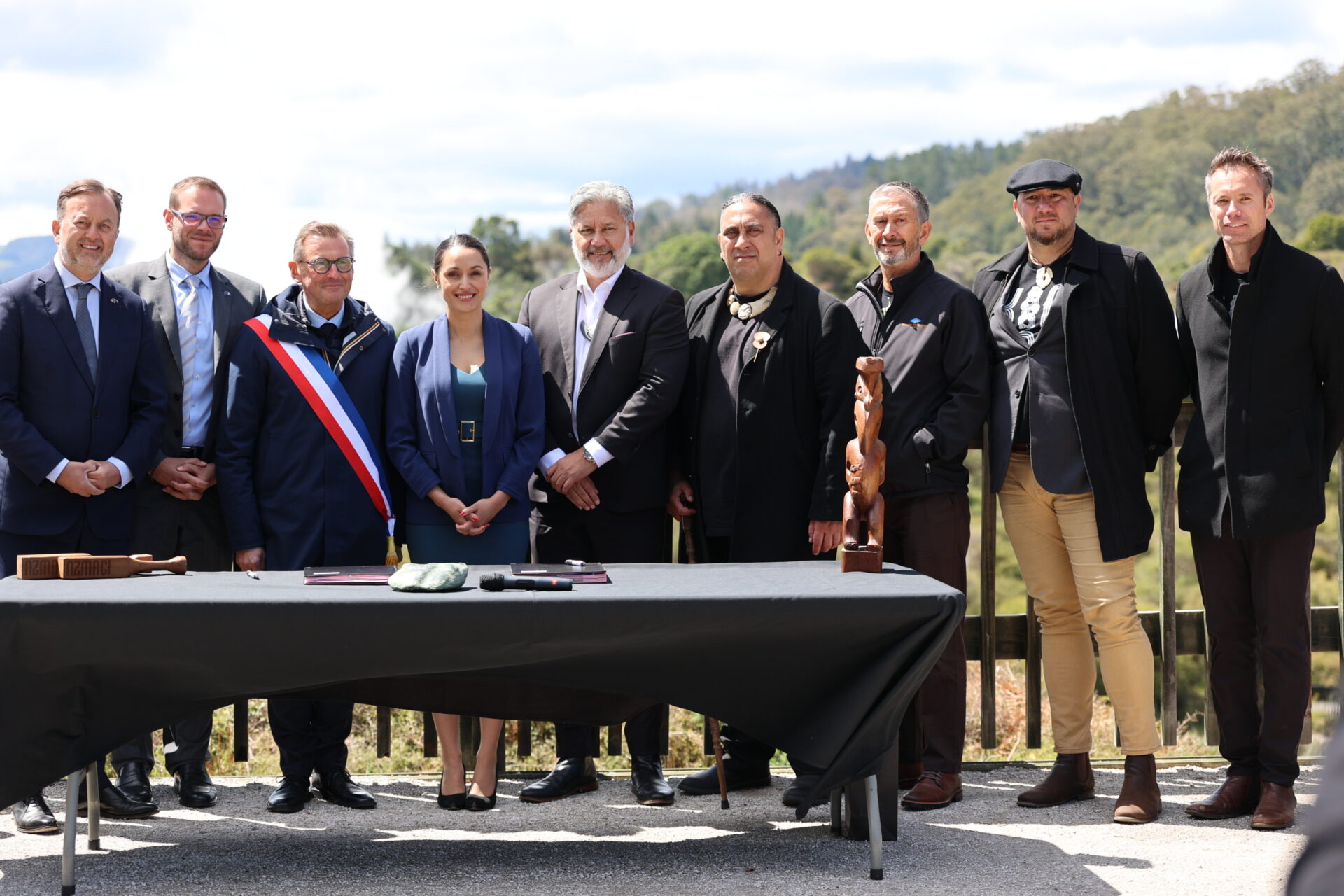
Delegation from the City of Arras in France alongside members of Rotorua Lakes Council and Te Puia | New Zealand Māori Arts and Crafts Institute (NZMACI).
On Friday 16 October 2026, a delegation from the City of Arras in France, led by Mayor Frédéric Leturque, came to Rotorua to sign agreements with Rotorua Lakes Council and Te Puia | New Zealand Māori Arts and Crafts Institute (NZMACI). Te Puia | NZMACI carvers are creating a Waka Maumahara, a vessel of remembrance, for the Wellington Quarry in Arras. The waka honours New Zealanders who served beneath the city in the First World War.
French Ambassador François Decoster attended the visit.
What is a Waka Maumahara?
A Waka Maumahara is a vessel of remembrance. Traditionally, when a waka (canoe) had completed its working life, it could take on a new purpose and become a place of memory and connection. In this way the waka continues to carry people, not physically, but through the stories and memories of those who have passed. That makes it an appropriate form of remembrance for the Battle of Arras.
Why is Arras connected to Aotearoa New Zealand?
The relationship dates back to 1916–17. Nearl 500 members of the New Zealand Engineers Tunnelling Company, including a detachment of 43 members of the Māori Pioneer Battalion, carried out an engineering feat 20 metres beneath the streets of Arras. It was in preparation for the Battle of Arras, the largest surprise attack of the First World War.
Over about six months, the New Zealand tunnellers extended a complex underground network of medieval chalk quarries. It was large enough to accommodate up to 24,000 soldiers. They named sections after places in Aotearoa and left inscriptions and memorabilia in the tunnels.
What is the Wellington Quarry in Arras?
The Wellington Quarry is part of that underground network and is now one of the most popular memorial tourism experiences in Northern France. It is also a place of pilgrimage and remembrance. It is where the Waka Maumahara will be installed.
What was agreed during the Arras visit?
Two charters were signed:
- Cooperation Charter: between the City of Arras and Te Puia | NZMACI.
- Twinning Charter: Rotorua Mayor Tania Tapsell and Arras Mayor Frédéric Leturque formally recognised the relationship between the two cities.
The joint intention is an ongoing exchange. It will share the story of Arras and the Wellington Quarry with audiences in Aotearoa, and support greater understanding and appreciation of Māori culture, arts and knowledge in France.
Who is carving the Waka Maumahara?
Te Puia | NZMACI carvers are creating the Waka Maumahara, which Arras commissioned for the Wellington Quarry. Some of the carvers working on the project have direct whakapapa links to Māori Pioneer Battalion soldiers who took part in the 1916–17 tunnelling.
At the time of the visit the waka was nearly halfway complete. The delegation saw the carving in progress, met the carvers responsible for its creation and experienced the living Māori cultural practice behind the work.
Learn more about the New Zealand Māori Arts and Crafts Institute and the National Wood Carving School at Te Puia.
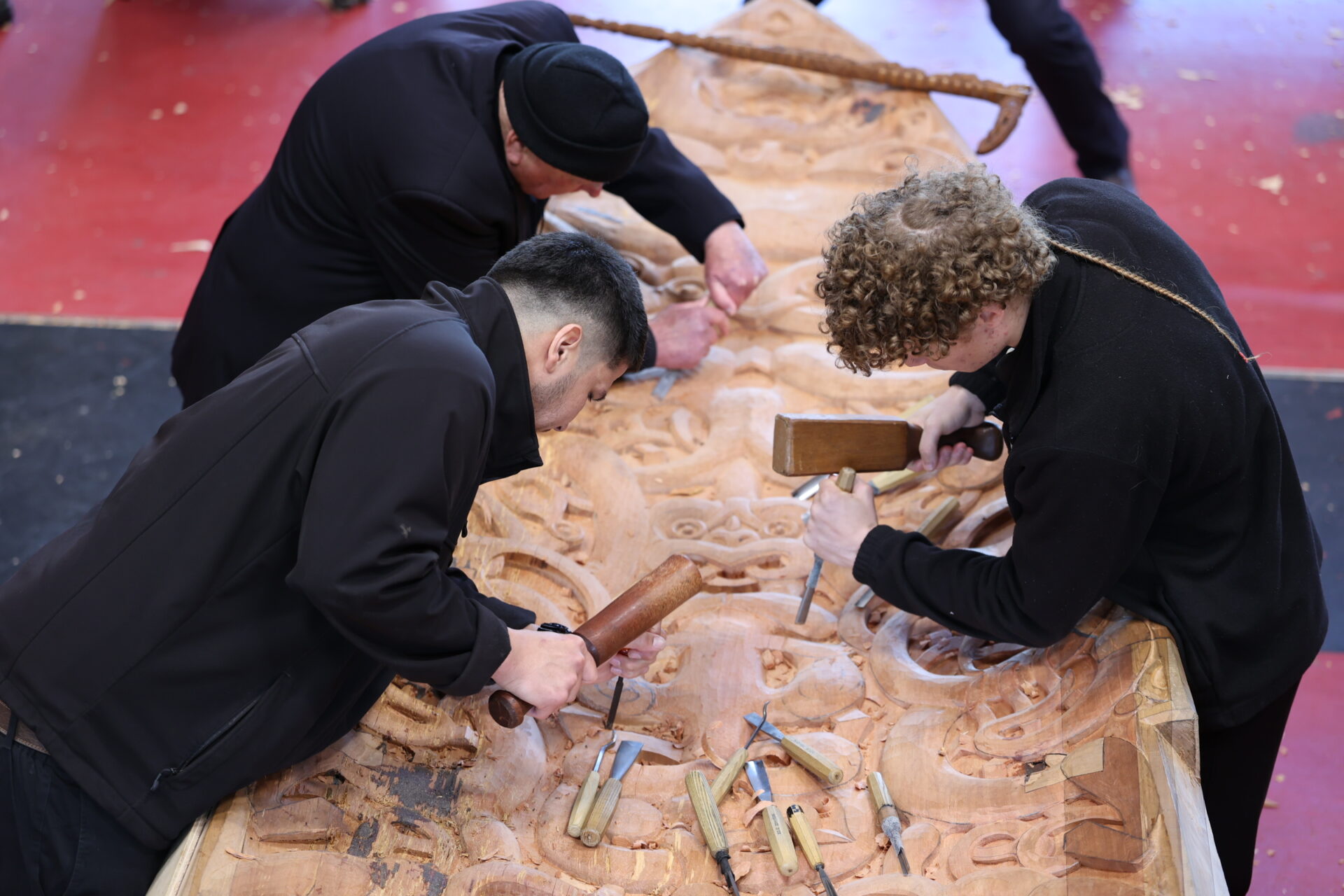
Te Puia | NZMACI Carves a Waka Maumahara for France.
What does this mean for Te Puia?
For Te Puia | NZMACI, the significance is threefold: remembrance, relationship and continuity.
- Remembrance: it honours New Zealanders whose service connected these two places more than a century ago.
- Relationship: it establishes a living relationship between institutions and communities today.
- Continuity: it creates a platform for future cultural, educational and artistic exchange.
Frequently asked questions
What is a Waka Maumahara? A vessel of remembrance. A waka that has completed its working life can take on a new purpose as a place of memory and connection, carrying the stories and memories of those who have passed.
What is the Wellington Quarry? Part of the underground network of medieval chalk quarries beneath Arras that New Zealand tunnellers extended in 1916–17. It is now a memorial tourism destination and place of remembrance in Northern France.
Who were the Māori Pioneer Battalion soldiers at Arras? A detachment of 43 members of the Māori Pioneer Battalion served alongside the New Zealand Engineers Tunnelling Company beneath Arras in 1916–17. Some of the carvers working on the Waka Maumahara have direct whakapapa links to these soldiers.
What is Te Puia’s connection to Arras? Te Puia is carving a Waka Maumahara commissioned by Arras for the Wellington Quarry. It has also signed a Cooperation Charter with the City of Arras.
Media covereage can be found on the following sites:
- Radio NZ video see here and article see here.
- NZ Herald article see here.
- One News article see here.
- Te Ao Māori News video see here and article see here.
- Aukaha News – see website feature here. A photo overview here and a Facebook Live of the signing here and here.
- Te Arawa FM – see the video story here, and a photo overview here.
- Frédéric’s posts here and here.